Views
500

AI AGENT SKILL EVOLUTION FRAMEWORK

Co-Skill: A Collaborative Communication Framework for Skill Evolution

Anon
15.6% - 41.9%

Reduction in total SLM+LLM token usage compared to state-of-the-art hybrid methods.

25.8% - 76.4%

Consistent improvement in task success rates across ALFWorld and WebShop benchmarks.

15.3% - 40.5%

Wasted tokens saved by eliminating cloud communication redundancy.

61.7% - 65.6%

Reduction in per-episode token cost relative to SkillRL after training stabilizes.

Overview of the Co-Skill framework for collaborative communication between cloud and edge LLMs.

Overview

Background
Agent evolution through skills is critical for LLM-based agents to iteratively improve task success rates. Hybrid evolution (cloud LLM generates skills, edge SLM executes) is a promising cost-efficient paradigm.

The Problem
Existing hybrid methods (e.g., SkillRL) suffer from low success rates and high token usage. This stems from "blind communication": the cloud cannot perceive the edge's execution capability, while the edge does not understand the cloud's analysis needs.

Our Solution
We propose the Collaborative Communication Framework (CCF) to achieve effective edge-cloud evolution. Experiments across ALFWorld and WebShop show that CCF reduces LLM+SLM token usage by 15.6%-41.9% while consistently improving task success rates by 25.8%-76.4%.
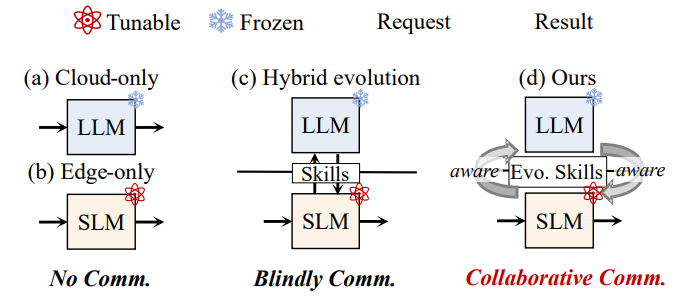
Evolution Paradigm Comparison

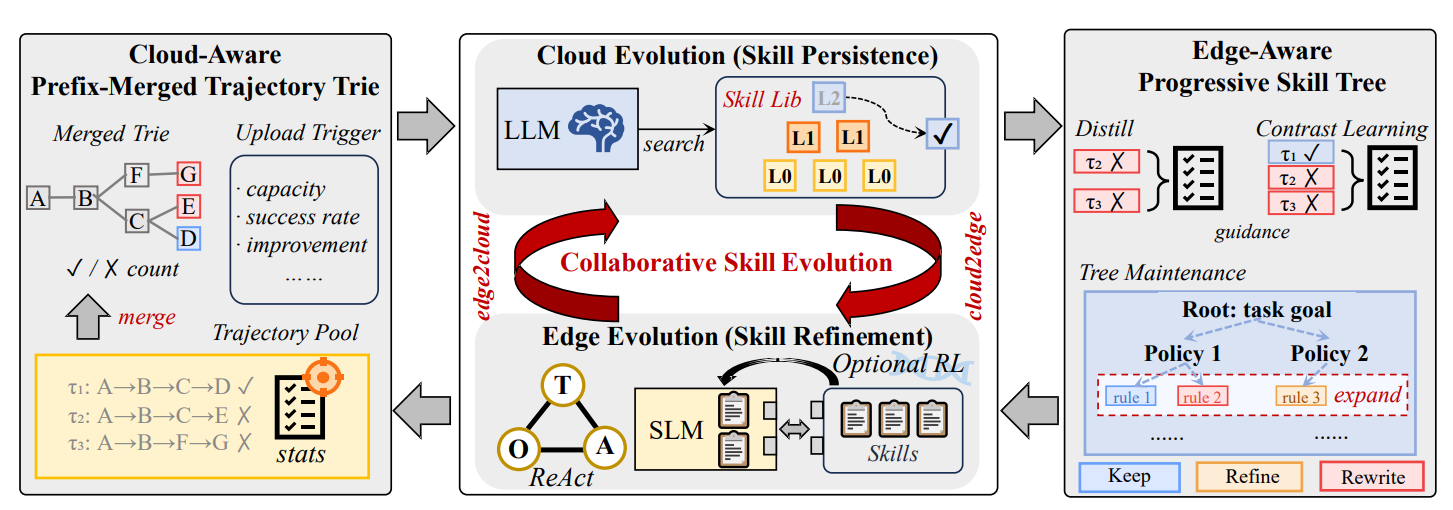
Overview of the Co-Skill architecture.

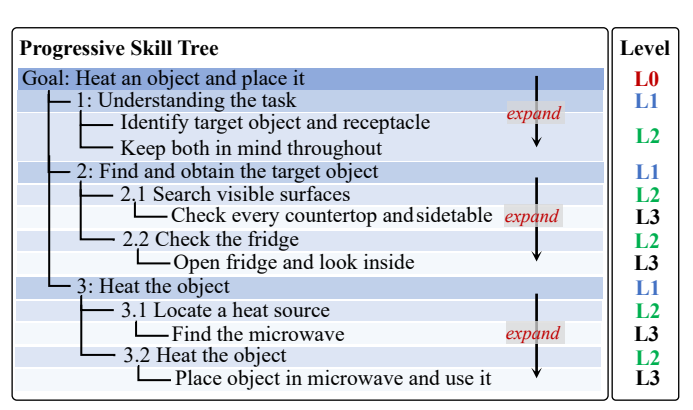
Co-Skill includes three major components: a cloud-aware prefix-merged trajectory trie that compresses edge-to-cloud traffic; an edge-aware progressive skill tree that organizes cloud-to-edge skills; and a collaborative skill evolution method that jointly evolves edge-cloud models.
Method

Co-Skill Framework Overview
The evolution paradigm comparison.

The Collaborative Communication Framework (CCF) is realized via three key techniques:

Prefix-Merged Trajectory Trie

Compresses trajectories by merging shared prefixes and pinpointing divergence points.

Progressive Skill Tree

Progressively builds a hierarchical skill tree to match edge SLM execution capability.

Collaborative Skill Evolution

Evolves cloud LLM and edge SLM in a separated way to jointly improve task success rate.

Cloud-Aware Prefix-Merged Trajectory Trie

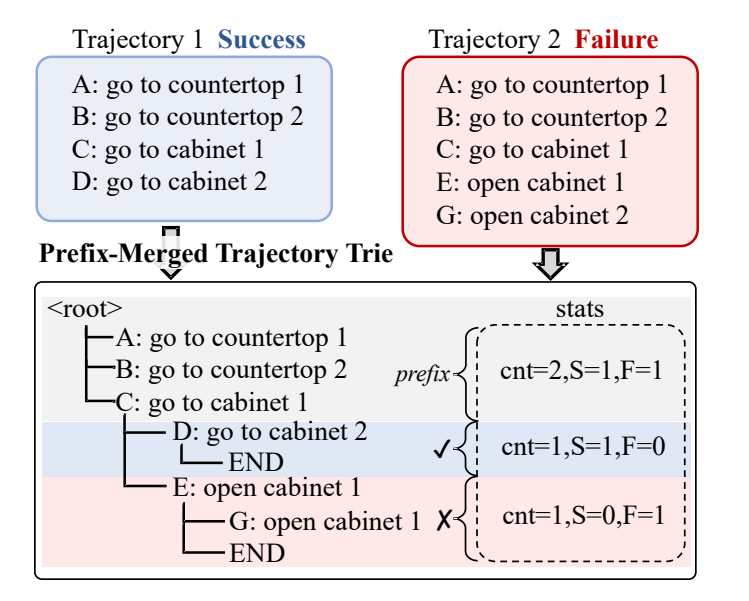
The edge agent compresses trajectories by merging shared prefixes and pinpointing divergence points. This eliminates redundant uploads and surfaces key decision forks for efficient cloud analysis.

Prefix-Merged Trajectory Trie
Edge-Aware Progressive Skill Tree

The cloud progressively builds a hierarchical skill tree to match the edge SLM's execution capability. It expands the tree only when the edge genuinely needs finer sub-steps.

Progressive Skill Tree
Collaborative Skill Evolution

Operating atop the two trees, the cloud LLM and edge SLM evolve separately. The cloud maintains a hierarchical skill library for persistence, while the edge learns improved skills with an optional RL module for internalization.

Experiments

We evaluate Co-Skill across standard interactive agent benchmarks: ALFWorld (household environment) and WebShop (e-commerce).

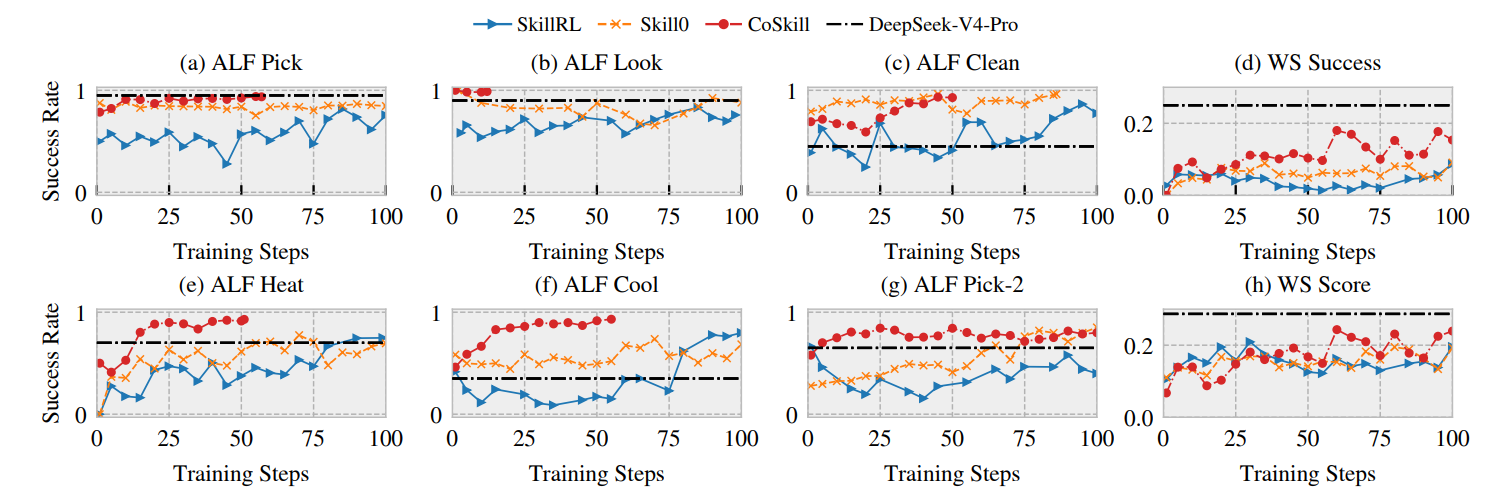
Task Success Rate

Across ALFWorld and WebShop workloads

Task Success Rate

Superior Task Success Rate: Co-Skill consistently surpasses edge baselines (e.g., Skill0, SkillRL) and approaches—or even exceeds—cloud-only evolution performance on complex multi-step tasks.

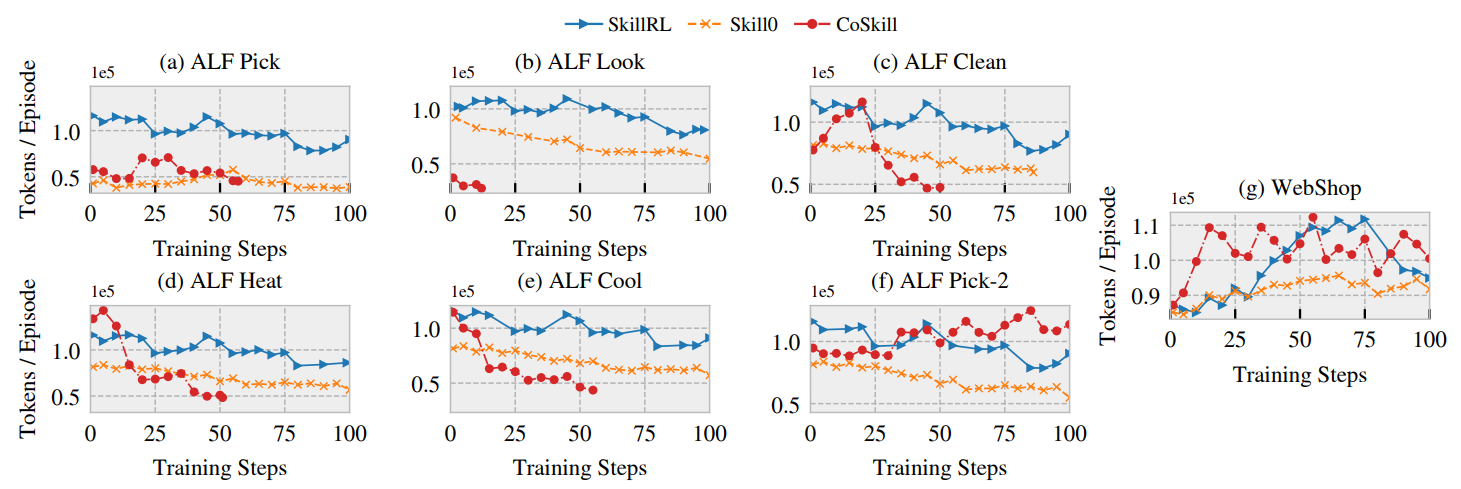
Token Usage per Episode

Average SLM+LLM token consumption

Token Usage

High Token Efficiency: Despite requiring comprehensive cloud analysis, total SLM+LLM token usage is reduced by up to 41.9%. This is achieved by the prefix-merged trie eliminating redundant transmissions and the cloud retrieving stored skills for recurring tasks.

Citation

@article{ma2025coskill,
  author    = {Ma, Yilin and Pan, Yangi and Yang, Weihao and Zeng, Peixin and Xu, Jiannan and Huang, Hao and Xia, Wen},
  title     = {Co-Skill: A Collaborative Communication Framework for Skill Evolution},
  journal   = {arXiv},
  year      = {2026},
}